Showing posts with label Treatment. Show all posts

Sunday, August 25, 2013

Osteoarthritis of the shoulder


Dear Reader,

Like my mother many people suffer from chronic severe shoulder pain caused by degenerative joint disease also known as osteoarthritis.

Osteoarthritis occurs when the bone protective- or articular cartilage wears down and causes swelling, inflammation, and pain. In some cases bone spur (osteophytes) growth might occur, as bone rubs against bone. The shoulder is made up of two joints, the acromioclavicular (AC) joint and the glenohumeral joint. The AC joint is located where the clavicle (collarbone) meets the acromion at the tip of the shoulder blade. The glenohumeral joint is the meeting point between the arm bone (humerus) and the scapular (shoulder blade).

In the majority of cases osteoarthritis of the shoulder or any other joint for that matter is found in people age 50 or older. In the earlier years osteoarthritis is typically caused by a traumatic injury to the joint. A very small percentage of young osteoarthritis patients have a genetic predisposition to the joint disease that causes an early onset.

When seeing an orthopedic specialist, he/she will most commonly start the diagnostic process by establishing a medical history and perform a physical exam looking for swelling, pain and tenderness. Often muscular weaknesses surrounding the joint is found due to pain induced inactivity. In addition x-ray and MRI can produce imagery that details the degree of degeneration of the joint more accurately.

Osteoarthritis of the shoulder can be treated conventionally, through medication, and surgically. The first step of treatment is to rest the shoulder and modify activities involving the shoulder. The application of ice or heat packs to reduce swelling, inflammation and pain and improve mobility are typically temporarily and do not eliminate the cause. Your physician might prescribe a physical therapy program focused on  stretching and strengthening muscles to improve joint range of motion.

Should these conventional methods fail to bring relief medications such as Non-Steroidal-Anti Inflammatory-Drugs (NSAID's: Ibuprofen, Naproxen, Aspirin) or Cox2 Inhibitors (Celebrex) can  be used to further reduce inflammation, swelling and pain. Advanced stages and severe shoulder pain is often treated with corticosteroid or hyaluronic acid injections. Steroid injections reduce swelling and thereby alleviate pain and decrease joint stiffness. Hyaluronic acid injections are known as "viscosupplementation" and help lubricate the joint similar to the way W40 works on mechanic joints.

If all non-surgical options are exhausted your physician will suggest either a total shoulder replacement (arthroplasty) or a partial replacement in which only the head of the humerus is replaced (hemiarthroplasty). Both these surgeries are performed to treat osteoarthritis of the Glenohumeral joint. The removal of a small section of the end of the collarbone known as resection arthroplasty is the common surgical choice to treat osteoarthritis of the AC joint.

In recent years stem cell research has created new hope for osteoarthritis patients. In the last years stem cells who help heal and regrow cartilage were used in the repair of small cartilage defects. Currently studies are ongoing to explore whether the same treatment can help grow whole joint surfaces such as knees and hips in a lab to resurface the degenerated joint. For now this is still science fiction but there is a great deal of optimism and reason to be hopeful.

Many of my arthritic clients ask whether exercising is beneficial and whether I would recommend exercising while in pain. My answer to both questions is YES.

Our joints need movement! Movement nourishes and promotes joint health. Maintaining strong muscles will help support the weakened joint structure and reduce joint stress as you move. Stretching muscles and utilizing gentle mobilization exercises will help maintain good functional range of motion allowing for optimal use of the joint. Cardio-vascular exercises help in the prevention of diseases commonly known to be associated with inactivity and manage body weight therefore reducing impact on spine and joints. In addition learning meditation and relaxation techniques have shown to reduce stress and pain.
The exercise choices and the workloads when exercising with osteoarthritis depend on the severity of the disease as well a the timing. Workloads and work-out intensities have to be reduced when training an arthritic joint. Certain exercises might require modifications or need to be avoided all together in order to reduce the risk of causing aggravation. During an acute phase of inflammation one should further reduce or even eliminate the workload and focus instead on flexibility and mobility exercises working around the pain rather than through the pain.

Exercise suggestions for Shoulder OA:

Overhead Shoulder Stretch:
Stand with feet shoulder wide apart, arms hanging in front of body. Interlock fingers with palms facing down. Stretch arms straight overhead with fingers interlocked and palms facing ceiling.

Hold stretch for 20-30 seconds
2-3 Repetitions


Crossover Shoulder Stretch:
Stand with feet shoulder wide apart. Reach with one arm across opposite shoulder bending elbow. Gently push elbow further towards opposite shoulder.

Hold stretch for 20-30 seconds
Repeat 2-3 times each side


Towel Shoulder Stretch
Feet shoulder wide apart. Hold towel in one hand, drop it down the spine, Grab low end with other hand and gently pull top hand down behind head.

Hold stretch 20-30 seconds
Repeat 2-3 times each side


Shoulder Blade Pinch:
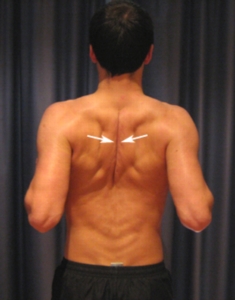

Stand with feet shoulder wide apart. Draw shoulders down and back until you feel your shoulder blades pinch in the back.

Hold for 5-10 seconds
Repeat 5-10 times


Rotator Cuff Strengthening
External Rotation

Stand with feet shoulder wide apart. Arms bend by your side at 90 degree angle. Grab elastic band with one hand and rotate outward. .

Repeat 10-20 times each side


Internal Rotation


Same position as before but this time arm rotates inward

Repeat 10-20 times each side.


These exercise are only a small selection and might not be suitable for everyone. Please talk to your physician and/or physical therapist before starting any exercise program.

I hope this short article is helping you understand your own condition or that of someone close to you. If you have any comments or questions please don't hesitate to email me.

Best,
Hartmut


References:


Web Md: http://www.webmd.com/osteoarthritis/guide/shoulder-osteoarthritis-degenerative-arthritis-shoulder
American Academy of Family Physicians: http://www.aafp.org/afp/2008/0901/p605.html
About.com: http://osteoarthritis.about.com/od/shoulderosteoarthritis/a/shoulder_OA.htm
Arthritis Health: http://www.arthritis-health.com/types/osteoarthritis/shoulder-osteoarthritis-treatment
NCBI: http://www.ncbi.nlm.nih.gov/pubmed/23190869
Science Daily: http://www.sciencedaily.com/releases/2013/01/130124163246.htm
Chicago Tribune: http://articles.chicagotribune.com/2013-04-24/health/sc-health-0424-arthritis-stem-cells-20130424_1_stem-cells-farshid-guilak-cartilage
Arthritis Foundation: http://www.arthritis.org/conditions-treatments/disease-center/osteoarthritis/

Saturday, June 29, 2013

Living and exercising with Prostate Cancer

Dear Friend,

a few days after the 12th anniversary of my father's passing, he had prostate cancer, and after a very close friend was recently diagnosed with the same disease I decided to dedicate this blog to all those who are or have been living with prostate cancer.

The prostate is a walnut sized gland between the bladder and the penis surrounding the urethra. It produces the seminal fluid that transports and nourishes the sperm.

Cancer of the prostate gland is one of the most common cancers in men. Even though the causes of the disease are still largely unknown we do know about risk factors that increase your chance to develop prostate cancer:

  • Age: Prostate Cancer is most common in men over the age of 65 and cancer cells are found in nearly 80% of men by age 80.
  • Ethnicity: Black male have an increased risk overall for developing prostate cancer and more aggressive forms of the disease in particular. Reasons unknown.
  • Family history: Any man like myself who has a family history of prostate cancer is at a higher risk than those without family history.
  • Obesity: Significantly overweight men who are diagnosed with prostate cancer show more often advanced disease which is much more difficult to treat.
Prostate cancer can in nature be slow growing or aggressive and be assigned one of four different stages. Stage 1: The Cancer is confined to a very small area in the prostate itself. Stage 2: The cancer is still small but maybe effecting both sides of the gland and/or deemed aggressive. Stage 3: The cancer has invaded other non prostate tissues surrounding the gland. Stage 4. prostate cancer cells are spreading throughout body by way of lymphatic system and blood stream and/or have grown into nearby organs.

The symptoms of prostate cancer often don't appear until the later stages:
  • Difficulty urinating (initiation and reduced force)
  • Blood traces in urin and/or semen
  • Swollen legs
  • Pelvic pain
  • Bone pain
Should you experience any symptoms that concern you please see your doctor for a detailed diagnosis. The initial screening test is typically  a digital rectal exam (DRE) in which the doctor inserts a lubricated, gloved finger into the rectum to determine if your gland shows any abnormalities in texture, shape or size. In case of a positive DRE a prostate-specific antigen test (PSA) may be needed. This test analyzes your blood for a higher than normal level of PSA which could indicate an infection, enlargement, inflammation or cancer of the prostate gland.

The next step often includes ultrasound to produce a better visual diagnosis and a  needle biopsy to collect a tissue sample that can be checked for cancer cells. If it is determined that the cancer has spread, further diagnostics are used to define the exact situation and decide the treatment options.

The treatment of prostate cancer depends greatly on the speed with which the cancer is growing, the extend to which it has spread as well as your doctor weighing benefits versus side effects.

Treatment options include:

Radiation Therapy either via high powered energy beams applied from the outside or a low long-term dose of radiation treatment by inserting small radioactive seeds into the prostate gland near the tumor. Side effects are rare but in very few cases can lead to other forms of cancer associated with radiation.

Hormone Therapy targets the male hormone testosterone which helps cancer cells grow. Testosterone production can be stopped or limited through medications which prevent signals to the testicles to produce testosterone or through medications that prevent testosterone from reaching the cancer cells. A more radical and often faster way to reduce testosterone levels is the surgical removal of the testicles called orchiectomy. Side effects can include erectile dysfunction, loss of bone mass, weight gain, reduced sex drive and increased risk for heart attacks.

Prostatectomy is the surgical removal of the prostate gland, some of the surrounding tissues as well as nearby lymph-nodes. Side effects may include urinary incontinence and erectile dysfunction.

Freezing and thawing cancer cells via the use of gases that freeze and reheat the cancerous tissues and finally kill the cancer cells This form of therapy is still in developmental stages but complications have been significantly reduced over past years and presents a possible treatment option for those who did not respond to Radiation Therapy.

Chemotherapy is a very aggressive form of treatment most commonly used for  advanced stage prostate cancer (spread to other parts of body) or in patients that did not respond to Hormone Therapy. The medication that kills cancer cells is commonly taken either via pills or given intravenously. Unfortunately chemo therapy despite great progress still presents a lot of unwanted side effects in most patients.

As always it is better to prevent disease rather than having to treat it. The risk of developing prostate cancer can be reduced through a diet that is rich in fruits and vegetables and favors real healthy food choices over supplements. Nutrients and vitamins that have been linked to the prevention of prostate cancer are lycopene (found in tomatoes) as well as vitamin E and selenium. However supplements including these vitamins/minerals don't show the same success as foods naturally rich in vitamin E and selenium. In addition to a healthful diet regular exercising on most days of the week seems to cut the risk of prostate cancer even more. Screening healthy men for prostate cancer, who are not showing any symptoms of the disease, is somewhat controversial amongst the different medical organizations. To decide whether or not screening is appropriate for you please discuss your particular situation with your physician.

Exercise and prostate cancer
 As a Physio-Therapist and Personal Fitness Trainer I am of course especially interested in how far exercising can help reduce the risk of developing prostate cancer and how those with prostate cancer respond to exercise as an additional form of treatment other than the ones discussed previously.

It seems that the majority of studies performed between 1989 and today show a probable connection between increased physical activity and decreased prostate cancer risk. This reduced risk is explained by way of hormone level regulation, the prevention of obesity, improved immune functions, and the reduction of oxidative stress that are all positively influenced through regular exercising. Exercising also has a positive effect on those undergoing treatment for prostate cancer. One study suggests that men can reduce their risk of prostate cancer progression and increase their chance of survival by adding physical activity to their daily routine. These benefits can even be attained  with moderate levels of physical activity (15 minutes per day); however exercising vigorously for three or more hours per week seems to be of greater value and reduce all-cause mortality by 49% and prostate-cancer-specific mortality by 61%. Scientist are starting to understand why vigorous activities are more beneficial quoting it's positive effects on DNA repair and cell-cycle pathways as well as gene expression changes. They found upregulated genes that included well known tumor-suppressor-genes such as BRCA1 and BARCA2 in men with prostate cancer who participated in a vigorous exercise protocol for more than three hours per week.

I think it is safe to conclude that exercise does not only help in the prevention of prostate cancer, but can also positively change the outcome of the disease. More studies and research are needed to explain the correlation between exercise and prostate cancer in detail.


I hope this blog has been able to provide you with some interesting and helpful information. Please feel free to share my blog with anyone you might think would be interested, and as always your question and comments are greatly appreciated.

Wishing you and your loved ones good health,
Hartmut

Sources:
www.mayoclinic.com
www.cancer.gov
Program in Human Biology, Stanford University California
Medscape Medical News
American Society of Clinical Oncology